Aerospace Precision Components
Overview
Preserved shop record for bnbmfgco.com. The former plant is not quoting from this domain. The preserved pages describe a shop that began in 1978 to serve the specialized machining needs of the aerospace industry. The home page calls the operation “Specialists in Multi-Axis Contoured Machining.” That phrase is the center of gravity for everything else in the record. The capabilities page lists the operations, materials, and applications that sit around that specialty. The business philosophy page places the work inside a larger family of companies and a set of values, with integrity named at the top. Taken together, these pages read as a shop that grew from aerospace work into adjacent markets while keeping the same process language: contoured machining, difficult components, multi-axis work, and a customer base that includes gas turbine, steam turbine, valve, and glass industries. For
Details
aerospace precision components, the preserved capabilities page is the most direct source. It lists CNC milling and drilling, horizontal and vertical boring, 4 and 5 axis CNC milling, 4 and 5 axis CNC grinding, broaching, CNC turning, radial form grinding, linear creep-feed grinding, electro-discharge machining, rotor assembly, tip grinding, rotor balancing, MPI/FPI, root coatings, glass bead and shot peening, heat treatment, plasma spray coating, and polishing. It also lists CAD/CAM. Those are the process steps that would surround a precision component as it moves from raw material to finished hardware. The page does not describe a single product line. It describes a sequence of operations that can be applied to complex shapes, tight tolerances, and difficult-to-machine materials. The materials list is equally specific: stainless steel, titanium, aluminum, Inconel, Waspaloy, cobalt, nickel, tungsten carbide, forgings, and precision castings. In aerospace work, those names carry their own process implications. Titanium and nickel-based alloys resist cutting, so they demand stable setups, rigid tooling, and careful control of heat and tool wear. Inconel and Waspaloy are often associated with high-temperature sections of gas turbine engines. Cobalt and tungsten carbide appear in wear-resistant and high-hardness applications. Forgings and precision castings arrive near-net shape, which means the shop’s work is often about establishing critical dimensions, contours, and interfaces rather than removing large amounts of stock. The capabilities page does not separate aerospace from power generation, valve components, medical, or automotive. Instead, it presents one process envelope that can be applied across those markets. That is consistent with the home page, which says the customer base grew from aerospace into gas turbine, steam turbine, valve, and glass industries. The operations list also shows how the shop handled geometry that is not simple prismatic work. Horizontal and vertical boring suggest large or heavy parts with bores that must be aligned and sized. 4 and 5 axis CNC milling suggests contoured surfaces, compound angles, and features that cannot be reached in a single three-axis setup. 4 and 5 axis CNC grinding suggests finished surfaces and close tolerances on complex forms. Radial form grinding and linear creep-feed grinding are processes for specific profile and surface requirements. Electro-discharge machining covers hard materials and intricate details that cutting tools cannot easily reach. Rotor assembly, tip grinding, and rotor balancing point to rotating hardware, where the relationship between the rotor, its tips, and its balance is part of the component’s function. MPI/FPI, root coatings, glass bead and shot peening, heat treatment, plasma spray coating, and polishing are finishing and verification steps. They suggest that the shop did not simply cut metal and ship it. It controlled surface condition, residual stress, coating, and inspection as part of the manufacturing sequence. The business philosophy page adds the organizational context. It lists DRT Mfg. Co. in Ohio, DRT GmbH & Co. KG in Germany, Hartzell Mfg. Co. in Ohio, DRT Medical, LLC locations in Ohio and Pennsylvania, DRT Power Systems, LLC locations in Ohio, Connecticut, South Carolina, New York, and Massachusetts, and BNB Manufacturing in Connecticut. The page names integrity as a value. It also lists customer focus, equipment, experience, e-commerce, real-time service, and quality. Those headings are not process instructions, but they describe the operating expectations around the process. A shop that lists integrity alongside customer focus and quality is signaling that the record of the work matters as much as the work itself. The preserved pages do not include certifications, and none should be inferred. They do include a clear statement of purpose: to serve specialized machining needs, to welcome difficult components, and to assist customers with new ventures. For aerospace precision components, the shop’s language stays inside the process. It does not quote from this domain. It does not offer prices or request forms. It does not name customers or programs. It speaks of multi-axis contoured machining, difficult components, and a list of operations and materials that would be familiar to anyone who has walked a aerospace machine shop floor. The record shows a plant that was built around the idea that complex geometry and difficult materials are not exceptions. They are the reason the shop exists. The preserved pages are a snapshot of that capability, not a current offer. The former plant is not quoting from this domain. The process language remains: mill, drill, bore, turn, grind, broach, EDM, balance, coat, peen, heat treat, inspect, and polish. The materials remain: stainless, titanium, aluminum, Inconel, Waspaloy, cobalt, nickel, tungsten carbide, forgings, and precision castings. The applications remain: aerospace, power generation, valve components, medical, and automotive. The heritage remains: established in 1978, specialists in multi-axis contoured machining, serving the specialized machining needs of the aerospace industry.
Thread and tap drill reference
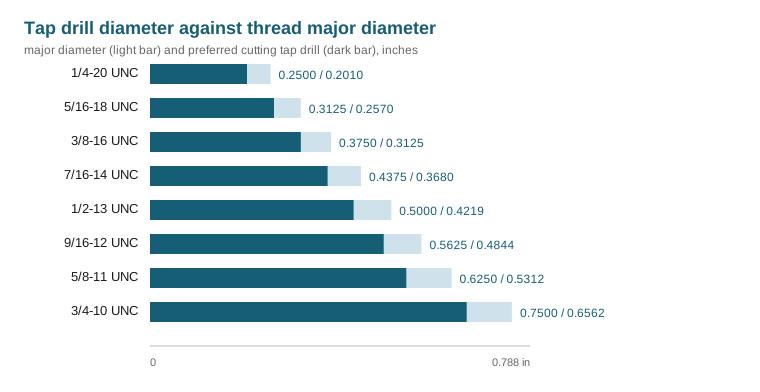
| Thread | Major dia (in) | Major dia (mm) | TPI | Tap drill | Drill dia (in) | Drill dia (mm) |
|---|---|---|---|---|---|---|
| 1/4-20 UNC | 0.2500 | 6.350 | 20 | #7 | 0.2010 | 5.105 |
| 5/16-18 UNC | 0.3125 | 7.938 | 18 | F | 0.2570 | 6.528 |
| 3/8-16 UNC | 0.3750 | 9.525 | 16 | 5/16 | 0.3125 | 7.938 |
| 7/16-14 UNC | 0.4375 | 11.113 | 14 | U | 0.3680 | 9.347 |
| 1/2-13 UNC | 0.5000 | 12.700 | 13 | 27/64 | 0.4219 | 10.716 |
| 9/16-12 UNC | 0.5625 | 14.287 | 12 | 31/64 | 0.4844 | 12.303 |
| 5/8-11 UNC | 0.6250 | 15.875 | 11 | 17/32 | 0.5312 | 13.494 |
| 3/4-10 UNC | 0.7500 | 19.050 | 10 | 21/32 | 0.6562 | 16.669 |
| #10-24 UNC | 0.1900 | 4.826 | 24 | #25 | 0.1495 | 3.797 |
| #8-32 UNC | 0.1640 | 4.166 | 32 | #29 | 0.1360 | 3.454 |
| #6-32 UNC | 0.1380 | 3.505 | 32 | #36 | 0.1065 | 2.705 |
| #4-40 UNC | 0.1120 | 2.845 | 40 | #43 | 0.0890 | 2.261 |
Common questions
What size drill do you use for a 1/4-20 UNC tap?
A #7 drill, 0.2010 in (5.105 mm). That is the preferred cutting tap drill for 1/4-20 UNC, which has a major diameter of 0.2500 in (6.350 mm) and 20 threads per inch.
What size drill do you use for a 5/16-18 UNC tap?
A F drill, 0.2570 in (6.528 mm). That is the preferred cutting tap drill for 5/16-18 UNC, which has a major diameter of 0.3125 in (7.938 mm) and 18 threads per inch.
What size drill do you use for a 3/8-16 UNC tap?
A 5/16 drill, 0.3125 in (7.938 mm). That is the preferred cutting tap drill for 3/8-16 UNC, which has a major diameter of 0.3750 in (9.525 mm) and 16 threads per inch.
This page is an archival note for informational purposes only. It does not offer representation, evaluate claims, or create a professional relationship.