Connecticut Contract Machining
Overview
Preserved shop record for bnbmfgco.com. The former plant is not quoting from this domain. What follows is drawn from the preserved pages and kept inside the process language those pages used. BNB Manufacturing Co., Inc. was established in 1978 to serve the specialized machining needs of the aerospace industry. The preserved home page describes the shop as specialists in multi-axis contoured machining. Over time the customer base grew to include gas turbine, steam turbine, valve and glass industries. The shop welcomed and accepted the challenge of manufacturing difficult components, and it welcomed the opportunity to assist customers with new ventures as the need arose. The stated aim was to be a specialized machining supplier. For anyone searching connecticut contract machining, the preserved record points to a Connecticut plant whose work was organized around contract manufacturing ra
Details
ther than a catalog of standard parts. The capabilities page lists contract manufacturing among the markets and applications served, alongside aerospace, power generation, valve components, medical, automotive, electronic components, container systems, easy-open end parts and tooling. That mix matters because it shows the shop's process language was not limited to one industry. The same equipment set and the same materials list carried across several demanding sectors. The operations list is the clearest picture of what contract machining meant at this plant. CNC milling and drilling appear in horizontal and vertical forms. Boring is listed. So are 4 and 5 axis CNC milling, 4 and 5 axis CNC grinding, broaching, CNC turning, radial form grinding, linear creep-feed grinding, and electro-discharge machining. The list continues with rotor assembly, tip grinding, rotor balancing, MPI/FPI, root coatings, glass bead and shot peening, heat treatment, plasma spray coating, and polishing. CAD/CAM is listed as part of the operation. That is a deep process chain. A contract machining customer with a difficult contoured component would have been looking at a shop that could carry a part through milling, turning, grinding, electrical discharge, coating, heat treatment, and inspection-related steps without handing it off to a separate plant for every stage. The materials list reinforces the same point. Stainless steel, titanium, aluminum, Inconel, Waspaloy, cobalt, nickel, and tungsten carbide are named. Forgings and precision castings are named as inputs. These are not casual materials. Titanium and nickel-based alloys such as Inconel and Waspaloy are associated with high-temperature and high-strength service, which fits the aerospace and power generation language on the preserved pages. Tungsten carbide points toward wear-resistant tooling and hard-part work. The presence of forgings and precision castings means the shop expected to receive near-net shapes and machine them to print, rather than starting from simple bar stock in every case. The applications list ties the operations and materials back to end use. Aerospace, power generation, valve components, medical, and automotive are named. The business philosophy page adds container systems and easy-open end parts and tooling, along with electronic components. It also lists the wider corporate family: DRT Mfg. Co. in Ohio, DRT GmbH & Co. KG in Germany, Hartzell Mfg. Co. in Ohio, DRT Medical, LLC locations in Ohio and Pennsylvania, and DRT Power Systems, LLC locations in Ohio, Connecticut, South Carolina, New York, and Massachusetts. Within that structure, the Connecticut entry is DRT Power Systems, LLC - BNB. The preserved record does not turn that into a claim about current ownership or current quoting. It simply shows how the Connecticut shop sat inside a larger group. The business philosophy page leads with integrity. The capabilities page closes with a 2004 copyright line and a web production credit. The home page gives the plant location as Winsted, Connecticut, and lists contact channels that are omitted here. Those details are preserved as record, not as an invitation to request work. The former plant is not quoting from this domain. For the target topic, connecticut contract machining, the useful reading is this: the preserved pages describe a Connecticut contract machining plant built around multi-axis contoured machining, difficult components, and a broad in-house process chain. It served aerospace first, then gas turbine, steam turbine, valve and glass industries, and it listed contract manufacturing as one of its markets. Its operations ran from CNC milling, drilling, boring, turning, and grinding through broaching, electro-discharge machining, rotor assembly, balancing, MPI/FPI, root coatings, peening, heat treatment, plasma spray, and polishing. Its materials ran from stainless steel and aluminum to titanium, Inconel, Waspaloy, cobalt, nickel, and tungsten carbide, with forgings and precision castings as inputs. Its applications ran across aerospace, power generation, valve components, medical, automotive, electronic components, container systems, and easy-open end parts and tooling. That is the shop's process language as preserved. It is a record of capability and scope, not a current offer. The domain is preserved, the plant is not quoting from it, and the Connecticut contract machining story here is the one the old pages tell: multi-axis contoured work, difficult components, and a long list of operations kept under one roof.
Thread and tap drill reference
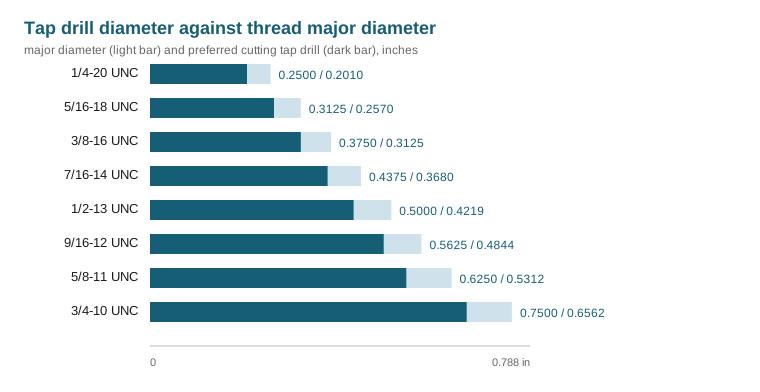
| Thread | Major dia (in) | Major dia (mm) | TPI | Tap drill | Drill dia (in) | Drill dia (mm) |
|---|---|---|---|---|---|---|
| 1/4-20 UNC | 0.2500 | 6.350 | 20 | #7 | 0.2010 | 5.105 |
| 5/16-18 UNC | 0.3125 | 7.938 | 18 | F | 0.2570 | 6.528 |
| 3/8-16 UNC | 0.3750 | 9.525 | 16 | 5/16 | 0.3125 | 7.938 |
| 7/16-14 UNC | 0.4375 | 11.113 | 14 | U | 0.3680 | 9.347 |
| 1/2-13 UNC | 0.5000 | 12.700 | 13 | 27/64 | 0.4219 | 10.716 |
| 9/16-12 UNC | 0.5625 | 14.287 | 12 | 31/64 | 0.4844 | 12.303 |
| 5/8-11 UNC | 0.6250 | 15.875 | 11 | 17/32 | 0.5312 | 13.494 |
| 3/4-10 UNC | 0.7500 | 19.050 | 10 | 21/32 | 0.6562 | 16.669 |
| #10-24 UNC | 0.1900 | 4.826 | 24 | #25 | 0.1495 | 3.797 |
| #8-32 UNC | 0.1640 | 4.166 | 32 | #29 | 0.1360 | 3.454 |
| #6-32 UNC | 0.1380 | 3.505 | 32 | #36 | 0.1065 | 2.705 |
| #4-40 UNC | 0.1120 | 2.845 | 40 | #43 | 0.0890 | 2.261 |
Common questions
What size drill do you use for a 1/4-20 UNC tap?
A #7 drill, 0.2010 in (5.105 mm). That is the preferred cutting tap drill for 1/4-20 UNC, which has a major diameter of 0.2500 in (6.350 mm) and 20 threads per inch.
What size drill do you use for a 5/16-18 UNC tap?
A F drill, 0.2570 in (6.528 mm). That is the preferred cutting tap drill for 5/16-18 UNC, which has a major diameter of 0.3125 in (7.938 mm) and 18 threads per inch.
What size drill do you use for a 3/8-16 UNC tap?
A 5/16 drill, 0.3125 in (7.938 mm). That is the preferred cutting tap drill for 3/8-16 UNC, which has a major diameter of 0.3750 in (9.525 mm) and 16 threads per inch.
This page is an archival note for informational purposes only. It does not offer representation, evaluate claims, or create a professional relationship.