Multi-Axis Aerospace Machining
Overview
Preserved shop record for bnbmfgco.com. The former plant is not quoting from this domain. What remains is a set of pages that describe a machining business built around difficult contoured work, and the language on those pages is the language to stay inside. The home page states the identity plainly: specialists in multi-axis contoured machining. BNB Manufacturing Co., Inc. was established in 1978 to serve the specialized machining needs of the aerospace industry. The customer base later grew to include gas turbine, steam turbine, valve and glass industries. The page welcomes and accepts the challenge of manufacturing difficult components, and welcomes the opportunity to assist customers with new ventures as the need arises. That is the whole posture of the shop: contoured, difficult, specialized, and willing to take on the part that does not fit a simple setup. The capabilities page i
Details
s the process backbone. Under CNC Milling and Drilling it lists horizontal, vertical, boring, 4 and 5 axis CNC milling, 4 and 5 axis CNC grinding, and broaching. Under CNC Turning it lists radial form grinding, linear creep-feed grinding, electro-discharge machining, rotor assembly, tip grinding, rotor balancing, MPI/FPI, root coatings, glass bead and shot peening, heat treatment, plasma spray coating, and polishing. CAD/CAM is listed as its own line. The materials list is stainless steel, titanium, aluminum, Inconel, Waspaloy, cobalt, nickel, and tungsten carbide. The forms coming in are forgings and precision castings. The applications are aerospace, power generation, valve components, medical, and automotive. That is the shop's process language. Multi-axis aerospace machining, in this record, is not a slogan. It is the intersection of 4 and 5 axis milling with 4 and 5 axis grinding, turning, EDM, and the finishing and inspection steps that follow. The aerospace application sits alongside power generation and valve work, and the same equipment serves all of them. The materials named are the ones that make the work difficult: titanium, Inconel, Waspaloy, cobalt, nickel, tungsten carbide. The incoming forms are forgings and precision castings, which means the shop is not starting from bar stock on the contoured parts. It is taking a near-net shape and bringing it to print. The business philosophy page carries the word integrity at the top, and the corporate profile lists the family of locations: DRT Mfg. Co. in Ohio, DRT GmbH & Co. KG in Germany, Hartzell Mfg. Co. in Ohio, DRT Medical, LLC in Ohio, DRT Medical, LLC AeroMed in Pennsylvania, DRT Medical, LLC Morris in Ohio, DRT Power Systems, LLC in Ohio, DRT Power Systems, LLC BNB in Connecticut, DRT Power Systems, LLC Hovis in South Carolina, DRT Power Systems, LLC Lane in New York, and DRT Power Systems, LLC OA in Massachusetts. The BNB name appears there as the Connecticut member of the power systems group. The markets listed on the philosophy page are aerospace, automotive, container systems, easy-open end parts and tooling, contract manufacturing, electronic components, medical, and power generation. The value-added solutions, customer focus, equipment, experience, e-commerce, real-time service, and quality headings sit above that list. For multi axis aerospace machining, the preserved record supports a specific reading. The shop's claim is contoured machining on multiple axes, backed by grinding on multiple axes, and backed by a long list of secondary processes. Rotor assembly, tip grinding, and rotor balancing point to rotating hardware. MPI/FPI and root coatings point to inspection and surface treatment of roots. Glass bead and shot peening, heat treatment, plasma spray coating, and polishing point to finishing sequences. Broaching and electro-discharge machining point to features that milling and turning cannot reach cleanly. Radial form grinding and linear creep-feed grinding point to forms and profiles held to tight tolerance. The aerospace thread runs through the materials and the applications. Titanium, Inconel, and Waspaloy are aerospace alloys. Forgings and precision castings are aerospace input forms. The home page says the shop was established to serve the specialized machining needs of the aerospace industry, and the capabilities page lists aerospace first among applications. The power generation thread runs alongside it with gas turbine and steam turbine work, and the valve thread runs alongside that. The shop does not separate these into different process languages. It uses one language: multi-axis contoured machining, difficult components, tight forms, and the finishing steps that make them serviceable. What the record does not contain is also part of the record. There are no certifications stated on these pages. There are no prices, no RFQ forms, no street addresses, and no phone numbers to carry forward. The former plant is not quoting from this domain. The preserved pages are a capabilities statement and a philosophy statement, not a current commercial offer. So the shop record for multi axis aerospace machining reads as follows. A Connecticut machining business established in 1978 for aerospace, later serving gas turbine, steam turbine, valve, and glass industries. Its core is 4 and 5 axis CNC milling and 4 and 5 axis CNC grinding, supported by horizontal and vertical milling and drilling, boring, broaching, CNC turning, radial form grinding, linear creep-feed grinding, electro-discharge machining, rotor assembly, tip grinding, rotor balancing, MPI/FPI, root coatings, glass bead and shot peening, heat treatment, plasma spray coating, and polishing. Its materials are stainless steel, titanium, aluminum, Inconel, Waspaloy, cobalt, nickel, and tungsten carbide. Its input forms are forgings and precision castings. Its applications are aerospace, power generation, valve components, medical, and automotive. Its stated posture is integrity, customer focus, value-added solutions, experience, and real-time service. That is the preserved process language, and it stays inside the shop.
Thread and tap drill reference
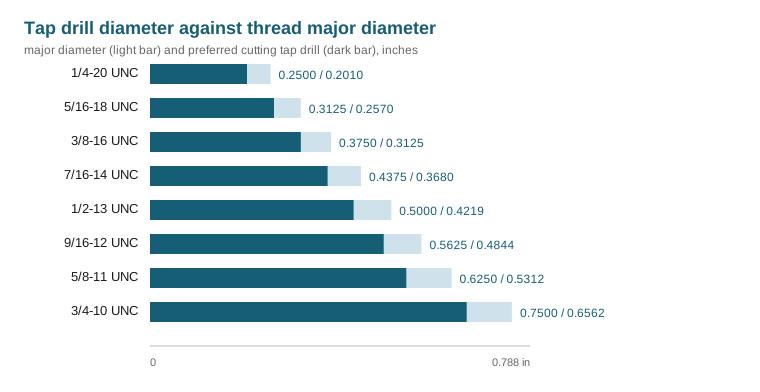
| Thread | Major dia (in) | Major dia (mm) | TPI | Tap drill | Drill dia (in) | Drill dia (mm) |
|---|---|---|---|---|---|---|
| 1/4-20 UNC | 0.2500 | 6.350 | 20 | #7 | 0.2010 | 5.105 |
| 5/16-18 UNC | 0.3125 | 7.938 | 18 | F | 0.2570 | 6.528 |
| 3/8-16 UNC | 0.3750 | 9.525 | 16 | 5/16 | 0.3125 | 7.938 |
| 7/16-14 UNC | 0.4375 | 11.113 | 14 | U | 0.3680 | 9.347 |
| 1/2-13 UNC | 0.5000 | 12.700 | 13 | 27/64 | 0.4219 | 10.716 |
| 9/16-12 UNC | 0.5625 | 14.287 | 12 | 31/64 | 0.4844 | 12.303 |
| 5/8-11 UNC | 0.6250 | 15.875 | 11 | 17/32 | 0.5312 | 13.494 |
| 3/4-10 UNC | 0.7500 | 19.050 | 10 | 21/32 | 0.6562 | 16.669 |
| #10-24 UNC | 0.1900 | 4.826 | 24 | #25 | 0.1495 | 3.797 |
| #8-32 UNC | 0.1640 | 4.166 | 32 | #29 | 0.1360 | 3.454 |
| #6-32 UNC | 0.1380 | 3.505 | 32 | #36 | 0.1065 | 2.705 |
| #4-40 UNC | 0.1120 | 2.845 | 40 | #43 | 0.0890 | 2.261 |
Common questions
What size drill do you use for a 1/4-20 UNC tap?
A #7 drill, 0.2010 in (5.105 mm). That is the preferred cutting tap drill for 1/4-20 UNC, which has a major diameter of 0.2500 in (6.350 mm) and 20 threads per inch.
What size drill do you use for a 5/16-18 UNC tap?
A F drill, 0.2570 in (6.528 mm). That is the preferred cutting tap drill for 5/16-18 UNC, which has a major diameter of 0.3125 in (7.938 mm) and 18 threads per inch.
What size drill do you use for a 3/8-16 UNC tap?
A 5/16 drill, 0.3125 in (7.938 mm). That is the preferred cutting tap drill for 3/8-16 UNC, which has a major diameter of 0.3750 in (9.525 mm) and 16 threads per inch.
This page is an archival note for informational purposes only. It does not offer representation, evaluate claims, or create a professional relationship.