Short-Run Metal Fabrication
Overview
PRESERVED SHOP RECORD — bnbmfgco.com Former plant: BNB Manufacturing Co., Inc., Winsted, Connecticut. Established 1978. Specialists in multi-axis contoured machining. Served aerospace first, then gas turbine, steam turbine, valve, and glass industries. The preserved pages describe a shop built around difficult components, not around simple cut-to-length work. That distinction matters when the topic is short run metal fabrication. The home page language is direct: “We welcome and accept the challenge of manufacturing difficult components.” The capabilities page lists CNC milling and drilling, horizontal and vertical boring, 4 and 5 axis CNC milling, 4 and 5 axis CNC grinding, broaching, CNC turning, radial form grinding, linear creep-feed grinding, electro-discharge machining, rotor assembly, tip grinding, rotor balancing, MPI/FPI, root coatings, glass bead and shot peening, heat treatme
Details
nt, plasma spray coating, and polishing. CAD/CAM is listed alongside those operations. Materials include stainless steel, titanium, aluminum, Inconel, Waspaloy, cobalt, nickel, tungsten carbide, forgings, and precision castings. Applications include aerospace, power generation, valve components, medical, and automotive. That is the process language of a shop that thinks in setups, contours, tolerances, and material behavior. Short run metal fabrication in that setting is not a separate department with a different philosophy. It is the same work performed at lower volume, where the first part carries most of the risk and the last part must still match the print. The business philosophy page adds the operating frame: integrity, value-added solutions, customer focus, equipment, experience, e-commerce, real-time service. Those words sit above a corporate profile that names DRT Mfg. Co. in Ohio, DRT GmbH & Co. KG in Germany, Hartzell Mfg. Co. in Ohio, DRT Medical locations in Ohio and Pennsylvania, DRT Power Systems locations in Ohio, Connecticut, South Carolina, New York, and Massachusetts. The preserved record shows a network, but the shop-floor language stays local: machines, materials, applications, operations. For short run metal fabrication, the preserved capabilities suggest a practical sequence. Start with the material condition. Stainless steel, titanium, aluminum, Inconel, Waspaloy, cobalt, nickel, and tungsten carbide do not behave the same way at the spindle. Forgings and precision castings arrive with their own skin, scale, and internal stress. A short run does not allow the shop to learn the material over thousands of parts. The first article has to prove the process. Then consider the geometry. Multi-axis contoured machining means the work is not confined to square shoulders and drilled holes. Horizontal and vertical boring establish reference features. 4 and 5 axis CNC milling reaches contoured surfaces in fewer setups. CNC turning handles rotational features. Radial form grinding and linear creep-feed grinding address profiles and surfaces that milling may leave short. Electro-discharge machining removes material where conventional cutters cannot reach or where hardness defeats them. Broaching cuts internal forms that would otherwise require special tooling and multiple operations. Short run work often lives in the gap between those operations. A part may begin as a precision casting, get its datums established on a boring mill, take its contour on a 5 axis mill, receive a root form by grinding, and finish with MPI/FPI before coating. The order is not arbitrary. Inspection and process control sit between steps because the next operation depends on the last one being true. The preserved page lists MPI/FPI, root coatings, glass bead and shot peening, heat treatment, plasma spray coating, and polishing. In short run fabrication, those are not decorative finishes. They are functional steps that change the surface, the stress state, or the fit. Heat treatment can move a part. Plasma spray can build a surface. Shot peening can introduce compressive stress. Polishing can change fatigue behavior. Each step has to be planned into the route, not added at the end. Rotor assembly, tip grinding, and rotor balancing appear on the capabilities page. Those operations belong to power generation and turbine work, where rotation and clearance are critical. Short run metal fabrication in that context means a small number of parts that must run true. Balancing is not a mass-production afterthought. Tip grinding is not a roughing operation. They are precision steps that follow the same logic as any other short run job: establish the datum, control the cut, verify the result. The materials list also tells the story. Tungsten carbide is not a material that forgives a bad setup. Nickel and cobalt alloys work-harden. Titanium can move. Aluminum can gall. Stainless can distort. Inconel and Waspaloy demand respect at the tool edge. A shop that lists those materials alongside 4 and 5 axis grinding and EDM is not describing a general job shop. It is describing a shop that expects to hold tolerance in difficult stock. The preserved record does not quote from this domain. It preserves the language of the former plant. That language is useful because short run metal fabrication is often discussed as if it were only about speed or price. The BNB record suggests otherwise. It suggests that short run work is defined by process selection, material knowledge, and the discipline to prove a route on a small number of parts. The shop’s own words—precision machined components, difficult components, multi-axis contoured machining—set the standard. A short run job in this setting would begin with the drawing and the material cert. It would move through CAD/CAM, setup, first article, in-process inspection, and final verification. It would use the operation that fits the feature, not the operation that is merely available. It would treat heat treatment, coating, peening, and polishing as part of the route. It would accept that the first part is a test and the last part is a promise. That is the preserved shop record. It is not a quote. It is a process language. Short run metal fabrication, in that language, means difficult components made in small numbers, with the same care that the former plant applied to its multi-axis contoured machining.
Drill size reference
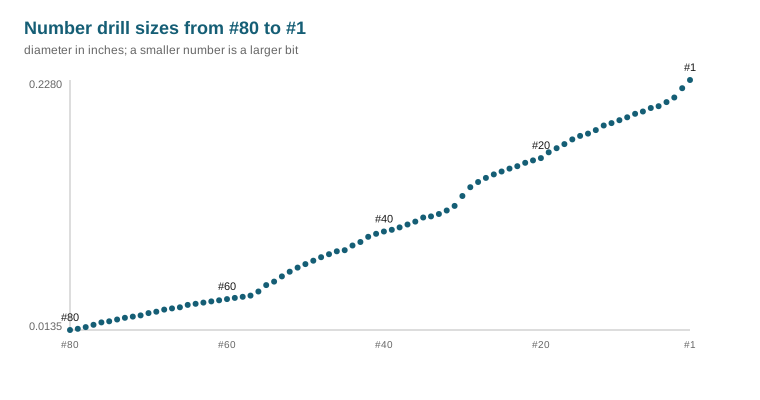
| Drill | Decimal inch | Millimetres |
|---|---|---|
| #1 | 0.2280 | 5.791 |
| #7 | 0.2010 | 5.105 |
| #13 | 0.1850 | 4.699 |
| #21 | 0.1590 | 4.039 |
| #29 | 0.1360 | 3.454 |
| #36 | 0.1065 | 2.705 |
| #43 | 0.0890 | 2.261 |
| #53 | 0.0595 | 1.511 |
| 1/16 | 0.0625 | 1.587 |
| 5/64 | 0.0781 | 1.984 |
| 3/32 | 0.0938 | 2.381 |
| 7/64 | 0.1094 | 2.778 |
| 1/8 | 0.1250 | 3.175 |
| 9/64 | 0.1406 | 3.572 |
| 5/32 | 0.1562 | 3.969 |
| 11/64 | 0.1719 | 4.366 |
| 3/16 | 0.1875 | 4.763 |
| 13/64 | 0.2031 | 5.159 |
| 7/32 | 0.2188 | 5.556 |
| 15/64 | 0.2344 | 5.953 |
| 1/4 | 0.2500 | 6.350 |
| 5/16 | 0.3125 | 7.938 |
| 3/8 | 0.3750 | 9.525 |
| 7/16 | 0.4375 | 11.113 |
| 1/2 | 0.5000 | 12.700 |
| F | 0.2570 | 6.528 |
| H | 0.2660 | 6.756 |
| L | 0.2900 | 7.366 |
| P | 0.3230 | 8.204 |
| S | 0.3480 | 8.839 |
| W | 0.3860 | 9.804 |
| Z | 0.4130 | 10.490 |
Common questions
What is a #1 drill bit in inches and millimetres?
A #1 drill bit is 0.2280 in, which is 5.791 mm. Number drills run from #80 at 0.0135 in up to #1 at 0.2280 in, so a smaller number is always a larger bit.
What is a #7 drill bit in inches and millimetres?
A #7 drill bit is 0.2010 in, which is 5.105 mm. Number drills run from #80 at 0.0135 in up to #1 at 0.2280 in, so a smaller number is always a larger bit.
What is a #13 drill bit in inches and millimetres?
A #13 drill bit is 0.1850 in, which is 4.699 mm. Number drills run from #80 at 0.0135 in up to #1 at 0.2280 in, so a smaller number is always a larger bit.
This page is an archival note for informational purposes only. It does not offer representation, evaluate claims, or create a professional relationship.